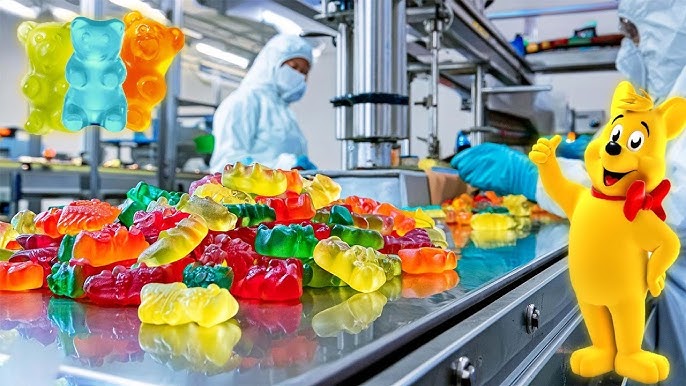
The confectionery industry has witnessed remarkable growth in recent years, fueled by rising consumer demand for innovative flavors, textures, and shapes. Jelly candies, in particular, have become a favorite due to their soft texture, vibrant colors, and versatile forms. To meet this growing demand efficiently, manufacturers increasingly rely on specialized equipment such as a Jelly Candy Making Machine. This machine is designed to automate key stages of production, improve consistency, and increase output, making it a crucial investment for modern confectionery businesses.
A jelly candy making machine integrates multiple production steps, including mixing, cooking, depositing, molding, cooling, and optional coating or packaging. By streamlining these processes, manufacturers can produce large volumes of candies with uniform texture, shape, and flavor. The machine’s precise control systems monitor temperature, viscosity, and portion sizes to ensure every batch meets strict quality standards. Its automation capabilities also reduce manual labor, minimize errors, and support continuous production.
Key Components of a Jelly Candy Making Machine
Understanding the main components of a jelly candy making machine is essential for optimizing its performance and ensuring high-quality output:
- Mixing Tank: The mixing tank combines ingredients such as gelatin, sugar, glucose, water, flavorings, and colorings into a uniform mixture. Modern machines often feature automated stirring and heating controls to maintain the correct consistency and prevent burning or crystallization.
- Cooking System: This system heats the mixture to achieve the desired texture while controlling moisture content. Some machines use vacuum cooking technology to improve flavor retention and create a smooth jelly mass.
- Depositing Unit: The depositing unit transfers the cooked jelly into molds. High-precision depositing ensures uniform candy size and weight, which is critical for packaging and quality control. Multi-nozzle depositing units allow simultaneous production of multiple candies, improving efficiency.
- Molding Section: Molds shape the candies into a variety of forms, from traditional cubes and bears to customized designs. Quick-change molds in modern machines enable fast transitions between product lines without downtime.
- Cooling Tunnel: After molding, candies pass through a cooling tunnel where they solidify and retain their shape. Controlled airflow and temperature prevent sticking, deformation, or uneven setting.
- Coating Unit (Optional): Some machines include coating systems to apply sugar, sour powders, or chocolate. Automated coating ensures even coverage, enhancing appearance while reducing manual labor.
- Control Panel: The control panel allows operators to manage parameters such as cooking temperature, mixing speed, portion size, and cooling time. Advanced systems offer programmable recipes and integrated quality monitoring.
Features Enhancing Efficiency and Product Quality
Modern jelly candy making machines are equipped with features that maximize efficiency, consistency, and overall product quality:
- Automation: Reduces manual labor and ensures continuous production with minimal errors.
- Precision Depositing: Guarantees consistent candy size, weight, and shape, which is critical for packaging and presentation.
- Multi-Flavor Capability: Supports simultaneous production of multiple flavors and colors.
- Hygienic Construction: Stainless steel components and easy-to-clean design meet food safety standards.
- Energy Efficiency: Optimized heating and cooling systems lower energy consumption and operational costs.
- Scalability: Modular designs allow manufacturers to expand capacity or add new features as demand grows.
Benefits of Using a Jelly Candy Making Machine
Investing in a jelly candy making machine provides numerous advantages for manufacturers:
- Increased Production Speed: Automated mixing, cooking, and depositing allow faster output compared to manual methods.
- Consistent Quality: Precise control of temperature, viscosity, and portioning ensures uniform taste, texture, and appearance.
- Lower Labor Costs: Less manual handling reduces dependency on operators and associated labor expenses.
- Product Flexibility: Supports various shapes, flavors, and coatings, enabling innovation and quick adaptation to market trends.
- Reduced Waste: Accurate portioning and consistent processing minimize material waste and rejected products.
Applications and Market Impact
Jelly candy making machines are used in factories producing a wide range of candies, including gummy bears, fruit-flavored cubes, sour gummies, and coated jelly products. Their ability to maintain consistency while scaling production makes them indispensable in competitive markets. The machine also allows manufacturers to experiment with innovative flavors, textures, and functional ingredients, helping brands differentiate themselves and meet evolving consumer preferences.
Conclusion
A Jelly Candy Making Machine is an essential investment for any confectionery manufacturer aiming to improve efficiency, ensure consistent product quality, and scale production effectively. By automating critical stages such as mixing, cooking, depositing, molding, and cooling, these machines reduce labor costs, minimize waste, and enable high-volume production.
The advanced features, hygienic design, and versatility of modern jelly candy making machines allow manufacturers to innovate, diversify product lines, and meet consumer expectations. For businesses looking to remain competitive in the dynamic candy market, adopting this technology is a strategic step toward increased productivity, profitability, and long-term success.
